
AI GTM Market Map Q2 2026
AI GTM Market Map Q2 2026
Editor’s note (July 2026): This narrative covers the Q2 2026 edition of the map. The live interactive map reflects the current landscape — including the Support & CX Agents category introduced in July 2026 and all funding events since. For the consolidation that reshaped the Intent & Signal column, see The Great Signal Grab.
The AI GTM market has matured enough that the map is no longer a flat list of point solutions — it is a layered architecture with distinct infrastructure, orchestration, and application layers. Q2 2026 marks the first quarter where consolidation has visibly reduced the vendor count in two categories (AI SDR and conversational AI) while new sub-categories have emerged in AI coaching and deal intelligence. What follows is the analyst view of where the market stands as of April 30, 2026.
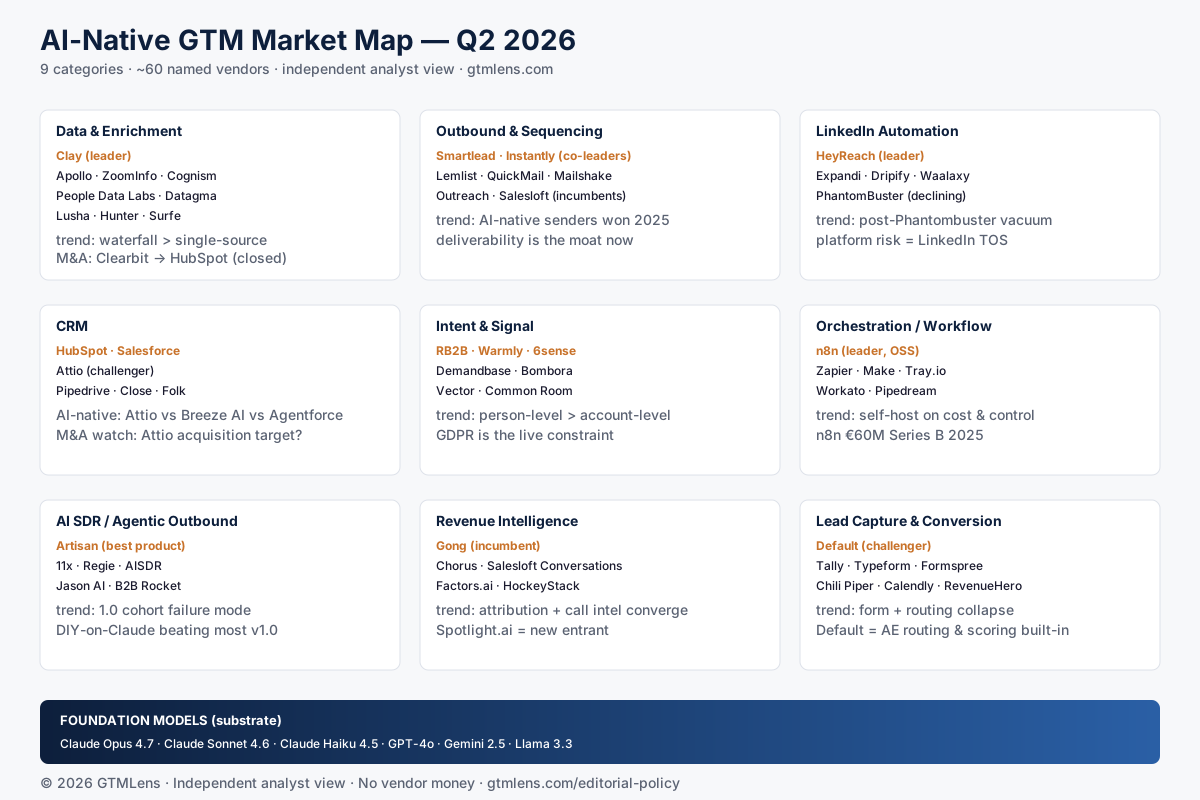
Category 1: Data Enrichment and Intelligence
Vendors: ZoomInfo, Apollo.io, Clay, Clearbit (now HubSpot), Lusha, Cognism, People Data Labs, Ocean.io, Keyplay, Bombora, G2 Intent, TechTarget Priority Engine, LeadIQ
Q2 2026 status: The enrichment layer continues to fragment. ZoomInfo’s repositioning as an AI platform (“ZoomInfo Copilot”) has not materially moved its competitive position against Clay’s waterfall model — enterprise teams still use ZoomInfo as one data source in a multi-vendor waterfall rather than as a single source of truth. Clearbit’s full absorption into HubSpot’s native enrichment is complete as of Q1 2026; standalone Clearbit API access remains but is no longer actively marketed to new customers.
Clay’s network effects are compounding: each new integration partner (42 as of Q2 2026, up from 30 in Q1 2025) adds waterfall depth. The platform’s Series C ($46M, a16z lead, February 2026) gives it runway through at least 2028.
Category 2: Outbound Sequencing and Delivery
Vendors: Smartlead, Instantly, Outreach, Salesloft, Apollo Sequences, Lemlist, Reply.io, Woodpecker, QuickMail, Mailshake
Q2 2026 status: The category has bifurcated into infrastructure-first players (Smartlead, Instantly) and all-in-one platforms (Outreach, Salesloft). The infrastructure-first segment is growing faster — Smartlead reportedly crossed $10M ARR in Q1 2026 on a bootstrapped model, a remarkable trajectory for a 3-year-old company. Outreach and Salesloft continue consolidation conversations; the rumored Outreach-Salesloft merger that circulated in Q4 2025 has not materialized as of this writing.
Lemlist’s $32M Series A (November 2025) funds aggressive product expansion into AI-personalization-at-send — generating the final email at send time rather than at campaign-build time. This is architecturally interesting but not yet proven at scale.
Category 3: AI SDR / Autonomous Outbound Agents
Vendors: 11x (Alice), Artisan (Ava), Piper (Qualified), Regie.ai, AiSDR, Jazon (Lyzr), Relevance AI SDR Agent
Q2 2026 status: This category is in its first wave of consolidation. Of the 20+ AI SDR vendors that were active in Q1 2025, at least 6 have either shut down, pivoted, or been acqui-hired. The survivors share a common characteristic: they are either best-in-class on a specific vertical (Artisan’s focus on SMB e-commerce) or have strong integrations with the dominant CRMs (11x’s Salesforce-native deployment).
11x raised a $24M Series A in January 2026 (Benchmark-led) and is the category leader by revenue. Artisan’s $25M Series A (October 2025) is funding a platform expansion beyond Ava into full-stack outbound infrastructure — a bet that the standalone AI SDR becomes a feature, not a product, and that survival requires becoming the platform. That is the right strategic read; expect further consolidation in H2 2026.
Category 4: Conversational Intelligence and Call AI
Vendors: Gong, Chorus (ZoomInfo), Clari Wingman, Salesloft Rhythm, Avoma, Fireflies.ai, Otter.ai, Grain, Nooks, Kaia (Demodesk)
Q2 2026 status: Gong remains the clear enterprise leader but faces increasing competition from native integrations — Salesforce’s Einstein Conversation Insights and HubSpot’s AI call summaries now cover 70% of the functionality that drove Gong’s initial adoption for SMB buyers. Gong’s moat is now its cross-account data model and revenue intelligence layer, not call transcription. The company’s Q1 2026 move to consumption-based pricing (away from per-seat) is strategically sound but will create short-term ARR volatility.
Nooks ($22M Series A, March 2026) is the most interesting new entrant — an AI-native parallel dialer that combines call AI with live coaching overlays. The product is targeting SDR teams, and early NPS data (shared in their launch materials) shows strong retention.
Category 5: Revenue Intelligence and Forecasting
Vendors: Clari, Gong Forecast, Salesforce Einstein Forecasting, HubSpot Forecasting, People.ai, Boostup (acquired by Mediafly, Q4 2025), Atrium, Scratchpad
Q2 2026 status: The Boostup-Mediafly acquisition (Q4 2025, terms undisclosed) removes one independent player from the mid-market. Clari remains the enterprise standard for AI-driven forecasting but faces CRM-native competition that is closing the feature gap. Clari’s response — deeper workflow automation and “Revenue Cadences” — is positioning it as a RevOps operating system rather than a forecasting tool. The repositioning is credible but requires execution over multiple quarters to validate.
Category 6: AI Coaching and Enablement
Vendors: Second Nature, Highspot, Seismic, Mindtickle, Showpad, Allego, Awarathon, Spekit
Q2 2026 status: AI coaching is the emerging sub-category with the most activity. Second Nature’s AI role-play product (practicing cold calls against an AI prospect) has reached product-market fit indicators — 3x YoY growth reported in their Q1 2026 update. Highspot and Seismic are both embedding AI coaching into their enablement platforms, which will commoditize standalone AI role-play for teams already on those platforms.
Category 7: Intent Data and Signal Intelligence
Vendors: Bombora, G2 Buyer Intent, TechTarget Priority Engine, 6sense, Demandbase, Aberdeen, Clearbit Intent (HubSpot), Slintel (ZoomInfo)
Q2 2026 status: 6sense and Demandbase continue their ABM platform consolidation, pulling intent data downstream into campaign orchestration. The standalone intent data vendors (Bombora, TechTarget) are increasingly becoming data wholesalers to the platforms rather than buyer-facing products. This is a structural shift — intent data is becoming infrastructure, not a standalone SaaS line item.
Category 8: AI Model Infrastructure for GTM
Vendors: Anthropic (Claude API), OpenAI (GPT-4o API), Google (Gemini API), Mistral, Cohere, AWS Bedrock (multi-model), Azure OpenAI
Q2 2026 status: This layer has stabilized into a two-and-a-half model market for GTM: Claude and GPT-4o as the production-grade options, Gemini as a credible third option for Google Workspace-heavy shops. Mistral and Cohere maintain positions in European data-sovereignty use cases. The model pricing war of H2 2025 has moderated — all major providers have found floor prices where margin is positive and further cuts would accelerate commoditization faster than new revenue growth can compensate.
Anthropic’s release of Claude Sonnet 3.7 (February 2026) with extended thinking capability materially improved performance on multi-step GTM reasoning tasks — the gap vs. GPT-4o on research and synthesis tasks widened in Anthropic’s favor. OpenAI’s response with GPT-4.5 (March 2026) closed some of the gap on personalization tasks.
Category 9: GTM Orchestration and Workflow Automation
Vendors: n8n, Make (formerly Integromat), Zapier, Clay (as orchestration), Common Room, Factors.ai, Census, Hightouch, Segment
Q2 2026 status: n8n’s $35M Series B (December 2025, Sequoia Europe-led) accelerates its enterprise GTM motion. The self-hosted model resonates with enterprise security requirements that prevent data flowing through third-party SaaS orchestration. Common Room ($50M Series C, January 2026) has successfully repositioned from community intelligence to a broader GTM signal aggregation and workflow platform — the rebrand-by-roadmap is working. Hightouch and Census continue their competition for the reverse-ETL / CRM sync category, with Hightouch’s AI Decisioning product (launched Q1 2026) as the most interesting product bet in the orchestration space.
M&A Activity: Q4 2025 — Q2 2026
- Boostup → Mediafly (Q4 2025): Revenue intelligence consolidation. Terms undisclosed. Mediafly gains enterprise forecasting; Boostup gains distribution.
- Clearbit → HubSpot (integration complete Q1 2026): Clearbit’s standalone API access deprecated for new customers; existing customers grandfathered through 2027.
- Slintel → ZoomInfo (integration deepened Q1 2026): Slintel’s technology intent data fully embedded into ZoomInfo’s data layer. The product is no longer accessible as a standalone purchase.
- Kaia AI → Demodesk (Q4 2025): Conversational AI for demos integrated into Demodesk’s meeting intelligence platform. Small acqui-hire scale.
Biggest Shifts vs. Q1 2026
- AI SDR category thinning: The 20+ vendor field of Q1 2025 is now closer to 8 viable vendors. Expect this to reach 4–5 by Q4 2026.
- Model infrastructure price stabilization: The pricing war phase is over. Budget models (Haiku, GPT-4o-mini) have created a two-tier market that drives high-volume classification workloads away from premium models.
- CRM-native AI closing the gap: Salesforce Einstein and HubSpot’s AI layer are now covering 60–70% of the use cases that drove third-party AI GTM adoption in 2024. This is deflationary for point solutions.
- Orchestration as the new moat: Teams that own the data pipelines and workflow automation layer own the AI GTM stack. Clay, n8n, and Common Room are the orchestration layer winners in their respective segments.
Q3 2026 Predictions
- At least one additional AI SDR vendor shuts down or pivots by September 2026. Most likely candidates are the smaller, undifferentiated players without a clear vertical or integration moat.
- Outreach or Salesloft announces a significant strategic transaction (merger, acquisition, or take-private) by end of Q3. The category cannot sustain two enterprise-scale platforms at current ARR multiples.
- A major CRM (Salesforce or HubSpot) acquires a mid-market revenue intelligence vendor to close the Clari gap natively. Atrium ($12M Series A, product-market fit evident) is the logical target.
- Anthropic and/or OpenAI launch GTM-specific model fine-tunes or vertical APIs, creating direct competition with the orchestration layer vendors that have built on top of their APIs.
Related: See the Anthropic/Claude vendor profile, the Clay vendor profile, and the Clay vs. Apollo comparison. For the previous market map, see AI GTM Market Map Q1 2026.

